Showing posts with label AUTOS. Show all posts

Wednesday, April 30, 2014

Latest Tech: The Mobile Phone Charger That Can Jump Start Your CAR

Have  you been embarrassed by your car battery before after the end of the work day or coming back from the mall just to discover that your car battery as gone flat due to your negligence to turn-off properly and no alternative available, then a solution is available


Sunday, March 16, 2014

Wont You Want To Join The Police; US Police Gets Lamborghini As Their Squad Car

The Los Angeles Police Department has gone and got themselves a Lamborghini.
With a starting price of $182,000, the 2014 Lamborghini Gallardo is the latest edition to the LAPD's fleet of vehicles, complete with traditional black and white paint and 'To Protect and to Serve' written on the sides, according to NBC Los Angeles.


The luxury ride is privately owned by Nathalie and Travis Marg of Light Source 1, Inc, a major telecommunications contractor.
According to officer Sally Madera, the car was donated to the department and will be used by police for 'charity events and recruitment'.

Friday, March 14, 2014

The Future In Mind; Cars Could Soon Be Reading Drivers Emotion

Safety has always been one of the prime motive every car manufacturer wants to ensures and achieve

Sooner in the future, dashboard emotion detectors could search for signs of irritation in a bid to identify the first signs of road rage.

A prototype of the device is able to read a driver’s facial expressions using a tiny embedded camera


Scientists at École Polytechnique Fédérale de Lausanne (EPFL), Switzerland, have developed the system which identifies which of the seven universal emotions a person is feeling: fear, anger, joy, sadness, disgust, surprise, or suspicion.

They believe their technology could be of use in medicine, marketing, gaming and in driver safety. 

‘We know that in addition to fatigue, the emotional state of the driver is a risk factor, the researchers said.

‘Irritation, in particular, can make drivers more aggressive and less attentive,’ they added.

The scientists worked with PSA Peugeot Citroën to create the prototype, which had to overcome the challenge of measuring emotions in the confines of a small space without distracting the drive

Researchers at EPFL’s Signal Processing 5 Laboratory came upon the idea of adapting a facial detection device for use in a car by using an infrared camera placed behind the steering wheel.

‘The problem was to get the device to recognise irritation on the face of a driver,’ they said, because everyone expresses this emotional state differently.

Research leaders Hua Gao and Anil Yüce chose to track only two expressions: anger and disgust, whose manifestations are similar to those of anger.


AND VOLVO ADDS A SCANNER THAT APPLIES THE BRAKES WHEN IT DETECTS A BICYCLE SWERVING INTO A CAR

Volvo has launched a revolutionary safety device that scans for cyclists and automatically brakes if a collision is imminent.

The Swedish car firm says the camera and radar-guided technology, which is being introduced into cars from May, could save hundreds of lives.

The system comprises a radar scanner in the grille, a camera fitted in front of the rear-view mirror, and an onboard computer. It allows the car to identify cyclists who swerve into its path and reacts by slamming on the brakes. 

The driver is given a loud audible warning and a visible warning of a row of red lights flashing up on the windscreen.

The new cyclist detector system comprises a radar scanner set into the car’s grille, a camera fitted in front of the rear-view mirror, and a computerised central control unit. 

The radar measures the distance to any suspicious object while the camera compares its shape and size against an electronic visual catalogue of thousands of images – including bicycles and cyclists. It can even differentiate between a pedal cyclist and a motor cyclist.
 

Radar: Computers calculate any possible collision and - if the driver ignores initial warnings - apply the brakes


Tuesday, February 18, 2014

Toks 2000/2001 Pathfinder @ Affordable Price


first body and never accidented
chilling ac
86k+ milage
all censor intact

contact 07036678911
pin: 79e70d35

Wednesday, February 5, 2014

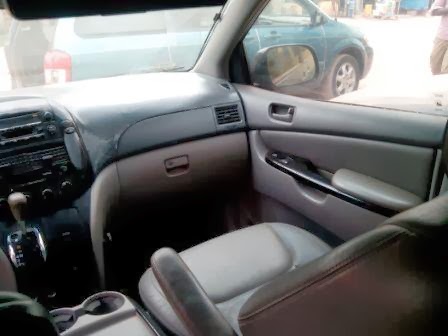
Mitnids Auto Sales- Toks 2005/2006 Sienna @ cheapest price

Feature of this Toks 2005/2006 Sienna:


  • Vehicle Anti-Lockout Device
  • Child Safety Door Locks Located On Sliding Van Doors
  • Vehicle Anti-Theft Via Alarm and Engine Immobilizer
  • Automatic Locking Power Door Locks
  • Selective Locking/Unlocking
  • Power Tailgate Lock/Unlock
  • Front Power 296-mm Disc and Rear Power 254-mm Drum Brakes
  • 4-Wheel Anti-Lock Brakes
  • Electronic Brake Assistance
  • Electronic Brake Force Distribution 
  • 3.3-Liter, V6, VVT-i 24-Valve, DOHC, MPFI Engine; Front Mounted With Horsepower Of 230@5600, Torque Of 242@3600
  • ULEV Emissions
  • Extended Service Interval For Spark Plugs and Distributorless Ignition
  • Chilling a/c
  • Installed dvd
  •  let forget all the English, just come to inspect and get convinced
  • price is 1.6m asking
  • location : iju
  • call Fred : 07036678911, 08091729174
  • pin 79e70d35 


Saturday, January 25, 2014

Nigeria love Cars: Check Out The Present Ranked No. 1 Luxury Ride

2013 Mercedes-Benz S-Class: Angular Rear

2013 Mercedes-Benz S-Class


2013 Mercedes-Benz S-Class: Angular Front


Mercedes-Benz S-Class Review

The 2013 Mercedes-Benz S-Class ranks 1 out of 10 Super Luxury Cars. This ranking is based on our analysis of published reviews and test drives of the Mercedes-Benz S-Class, as well as reliability and safety data.

Balanced performance and an exceptionally-luxurious interior make the 2013 Mercedes-Benz S-Class a serious competitor among super luxury cars.

Watch video:


The 2013 Mercedes-Benz S-Class is available with six different engines, ranging from a turbodiesel V6 in the S350 Bluetec all the way up to a twin-turbo V12 in the high-performance S65 AMG. Test drivers say that the S350 Bluetec has plenty of power, and that its seven-speed automatic transmission operates smoothly. The S350 gets 21/31 mpg city/highway, which is better than most super luxury cars, including its sibling, the Mercedes S400 Hybrid. If you want more power, the 2013 Mercedes S550 comes with a twin-turbo V8 that test drivers love. Few critics compare the 2013 S-Class to a sports sedan, but most agree that it strikes a good balance between comfort and sport, with composed handling and a comfortable, quiet ride. Additionally, one reviewer praises the S-Class for its strong brakes and excellent steering feel.   

Test drivers say that elegant interior styling and a wealth of high-quality materials make the 2013 S-Class’ cabin a great place to spend time. They note that both rows of seats are spacious and comfortable, and they’re particularly impressed by the massaging multicontour front seats that are now standard for 2013. Some critics note that Mercedes’ COMAND infotainment system could be easier to use. The 2013 Mercedes S-Class comes standard with heated and ventilated front seats, a power trunk lid, a rearview camera, adaptive high beams, navigation and a Harmon Kardon stereo system, which includes a six-disc CD/DVD changer, Bluetooth and an iPod interface. Available features include a heated steering wheel, panoramic moonroof, adaptive cruise control, four-zone automatic climate control, a Bang & Olufsen sound system, night vision with pedestrian detection and blind spot monitoring and lane departure warning systems

Sunday, July 14, 2013

Most expensive car ever sold at auction fetches $29 million


The Mercedes-Benz W196 einsitzer is pictured ahead of its auction by Bonhams at the Goodwood Festival of Speed at Goodwood near Chichester in southern...
LUKE MACGREGOR / Reuters
The Mercedes-Benz W196 einsitzer is pictured ahead of its auction by Bonhams at the Goodwood Festival of Speed at Goodwood near Chichester in southern England July 11, 2013.
A 1954 Mercedes Benz Formula One racer just became the most expensive car ever sold at auction.
Bonham's, the auctioneer, confirms that it brought the hammer down on the Mercedes Benz W196R at $26.45 million—with the buyer's premium the total price is $29.6 million. That tops the previous record for the most expensive car sold at auction, a 1957 Ferrari 250 Testa Rossa Prototype, sold for $16.39 million at Gooding & Company's 2011 Pebble Beach Auction.
The sale, at the Goodwood Festival of Speed Auction in the U.K., shows that the collectible car boom is continuing to rage on —especially for rare cars with strong racing histories. The famous race car driver Juan Manuel Fangio drove the Mercedes W196 to victory in two Formula One races— the 1954 German and Swiss Grands Prix.
The single-seat racing car car also had a great history, with well-documented ownership over the past half-century and very few major changes or modifications to the car.

"It's highly original," said Jonathan Klinger of Hagerty, the collectible-car insurance firm. He said that for a buyer "you're really looking at a club of one. It's not like another one will come down the road for sale."
Klinger, who attended the auction, said there were bidders from four continents for the car. That shows just how global the collectible car market has become, with new millionaire and billionaire collectors coming out of Asia, Latin America and the Middle East.
The identity of the buyer was not disclosed, although many attendees said the buyer was a phone bidder.

The Mercedes raced in five World Championship-qualifying Grand Prix races before it was retired from the Mercedes racing team at the end of 1955. The car was then prepped to full race standard and consigned to the Daimler-Benz Museum on Dec. 22, 1955.
In June 1965, it was exhibited in Munich, and during 1966 it was shown at both Le Mans in France and Hockenheim in Germany. It then appeared at the 1967 British Grand Prix at Silverstone, before being run in a test at the Untertürkheim factory test-track, and displayed in Berlin. In November 1967, it was exhibited at Stuttgart University.

On May 22, 1973, Mercedes-Benz officially presented it to the National Motor Museum in Beaulieu, Hampshire, England. But in the 1980s, the car was sold into private hands and preserved for years in a warehouse.


Monday, June 10, 2013

The Fastest And Most Expensive Cars

Here are the cars that will have you ‘wowing’ at its features and most especially, its prices.
L

Lamborghini Veneno - $4million

It’s too late to pick up one of these beasts, as all three that will be built sold before it even hit the showroom floor. Packing a 6.5 liter V12 with a maximum speed of over 220 miles per hour, this car is out of reach to most of us. The lucky few may spot it on the street, however, as two models have been bought by Americans.

W Motors Lykan Hypersport - $3.4 million


Expensive
supercars have long been common in Europe, but the Lykan Hypersport hopes to make history as “the first Arabian hypercar.” Debuted at the 2013 Qatar Motor Show, the Hypersport features an engine with 750 horsepower and a top speed of 245 mph. Plus, with its diamond-crusted LED headlights, there’s no hiding this hypercar’s over-the-top price tag.

Bugatti Veyron Super Sport - $2.4 million

Not just the most expensive car in the world, the Bugatti Veyron Super Sport is also the proud owner of the title as fastest street legal car in the world. With a top speed of 267.8 miles per hour, the Veyron isn’t likely to be outpaced by its competitors in speed or price any time soon.

Aston Martin One-77 - $1.85 million

As its name suggests, only 77 examples of this ultra-high-end Aston Martin have been built. Its 220 mph top speed may pale in comparison to the Veyron Super Sport, but its 750 horsepower V12 engine is nothing to scoff at.mitnids.blogspot.com/fastest&expensivecars

Saturday, May 11, 2013

latest On Car Tips: Repairs Every Car Owner Should Know (PART2)

Beyond changing an engine or repairing the transmission, there are a few basic fixes all car owners should have under their driving belt. The life expectancy of an automobile relies upon responsible maintenance. Although car services extend certain repairs, there are five quick fixes and changes any vehicle owner should be able to execute:
  • Battery change
  • Adding brake fluid
  • Oil change
  • Changing a Tire
  • Windshield wipers Replacement

10-Steps for Changing a Battery
1) For environmental-correctness, exchange the old battery with a new one.
2) Under the hood, the battery is usually located on the left side.
3) On the old battery, disconnect the cable terminals. First unplug the black terminals (negative) and then the red terminals (positive).
4) Dismantle the bracket or frame that holds the battery in position.
5) Then pull and lift the battery out of its position.
6) If the cable terminals are dirty or corroded, wipe them with water, a wire brush and baking soda.
7) Employ a wire brush to graze the inside of each cable terminal. The idea is expose clean metal to the new battery terminal. (Remember to replace the cable terminals if they are damaged.
8) Affix the new battery into position. Place both the negative and positive in the qualified positions. Then secure the frame.
9) Re-connect the battery with the cables securely. If the cable ends are movable they are not secure and will prevent the vehicle from starting, properly.
10) To test your work, start the engine.
Checking Brake Fluid
Brakes and its fluid are critical aspects of the performance of any car. To check brake fluid, first locate the brake master cylinder. Generally, it can be found on the driver's side of the car near the exterior of the engine area. As a guide, think of where the brake pedal is when it is engaged. The way to identify the brake master cylinder is by metal tubes, a rectangular piece of metal covered in a plastic reservoir by a rubber cap on top. It should be small, roughly 6 by 2 inches.

1. To confirm that you have located the master cylinder, refer to the auto's manual. Typically, the rubber cap will have the following inscription: 'Use only DOT 3 or 4 brake fluid from a sealed container.'

2. On newer automobile models, the reservoir is lucid. The fluid level may be visible without removal of the cap. When the brake fluid is full, it will go up to the line.
3. Prior to 1980, the brake master cylinder reservoir was for the most part comprised of metal. On these, car models, the top must be removed to gauge the fluid level. Since the cap is fastened by a metal clamp' dislodge with a screwdriver. It should effortlessly pop off the clamp. Then the lid will lift out easily.
4. Obviously, use the appropriate brake fluid to the vehicle accordingly. (Review the manufacturer's guide to determine the grade of brake fluid the automobile requires).
Important note: The toxicity of brake fluid is very high. Avoid contact with eyes and hands. Do not spill brake fluid on the pain of the car or the ground. Caution is advised when discarding the empty container.

5.Simply, pour the brake fluid to the designated 'full line.'
Recommendation: If the brake pedal goes to the floor, it is a sign that the brake master cylinder is empty. In this scenario, adding brake fluid and bleeding the brakes is necessary; as a result, it is best to see a mechanic to flush and refill the braking system. As all cars show different signs of needing new brake shoes, inquire about the symptoms of your vehicle.

Changing Motor Oil
It's the type of service every car needs every 3000 miles. Without an oil change, an engine can blow or it will cause the car to malfunction. Depending on where you live in the country, oil changes range from $19.00 to $50.00. For the do-it-yourself types or just to save money, use the following tips to change your oil:
1. Allow your vehicle to run until the engine is warmed
2. Depending on the model of your car, the auto may need to be jacked-up to reach the sump plug or is accessible by sliding underneath.
3. On the top of the engine, there should be a cap with the word oil. Unscrew the oil filler cap on to enable the oil to drain through easier.
4. Place a pan 9 x 12 x 4 pan underneath the sump plug. Unscrew the oil sump plug and allow the warm old oil flow into the container or pan. (Stay out of the way to avoid being burnt).
5. Allow the oil to drain out entirely.
6. Then dismantle the old oil filter and affix the new filter.
7. Screw in the oil sump plug tightly. Pour the appropriate grade of oil in through the oil filler. Then screw back the oil filler cap. Avoid overfilling. Make sure sufficient amounts of oil are poured in.
8. To test the success of the oil change, start your engine. Resituate the automobile and allow it to run for 5 minutes and
then check for any leaks on the surface underneath the car.
9. Then to gauge the level of fluid, check the oil dipstick.
10. After you If everything is OK you have saved yourself time and money but, more importantly, you know the job has been done properly.

Changing a Flat Tire
Changing a tire is one task all drivers dread; but it is a much needed know-how. Use the following safety and how-to tips for making a tire change.

1. First, pull of a secure side of the road.
2. On level terrain, place the vehicle in park and engage the parking brake.
3. Turn-off the engine and turn on the hazard lights.
4. Open the hood to demonstrate repairs.
5. Contingent upon the placement of the car, place a large stone in front for downhill, behind for uphill, or diagonally to the opposite wheel. All rock placements are to prevent the vehicle from rolling. It should be done even on moderate inclines.
6. Remover the extra tire (spare), car jack and tire iron (lug nut wrench)
7. Pop out the hubcap.
8. Prior to jacking up the automobile, loosen the lug nuts that hold the tire in position.
9. Enclose the tire iron over a lug nut.
10. Remember, to loosen the lug nut, turn the lug nut wrench counterclockwise. (Use this word association rhyme remember the laws of loosening and tightening: 'lefty loosy - righty tighty)
11. Work in a zigzag pattern to loosen the lug nuts. The idea is to loosen all nuts at the length, a few turns. Then, distribute the looseness by going back and forth between lugs.
12. With care, jack up the car. Make sure that the jack is rigged under the vehicle per the safety recommendations of the manual. Continue to jack the car up until it is comfortable to remove and replace the tires.
13. Unscrew the lug nuts completely and place them in an accessible location.
14. Take away, the flat tire.
15. Pick up the new tire and hoist it onto the wheel studs. The best way to verify that you are placing the tire on correctly is if the air valve is facing outward.
16. Start tightening the lug nuts in the same fashion in which they were removed zigzag. For example, apply two turns to each lug nut, then go to the opposite until you've worked your way around all. Avoid tightening any lugs that are adjacent to each other consecutively - it may inhibit other lugs from being tightened appropriately.
17. Lower the very slowly lower. Then return it to the trunk.
18. Give the lug nuts one more tightening and then put the hubcap on.

Windshield Wiper Basics
Screeching windshield wipers is the warning sign that a replacement is necessary. One of the most annoyingly labor intensive replacements on a car are the windshield wipers. As straightforward as the process may seem, it will require a little practice for perfection. After buying the appropriate and entire replacement windshield-wiper blades, use the following steps:


1. In the package, identify the attachment that is matches the wiper blade.
2. Review the directions to understand how to configure the blade.
3. Lift the wiper arm away from the windshield.
4. Dislodge the old wiper blade. (The blade is located on the wiper arm). Remember to push on the tab and pull the wiper blade off. As an alternate, the tab can be lifted with a small screwdriver.
5. Append the attachment on the wiper arm or the new blade. Depending on the model of your vehicle, it may prove to be easy to apply the attachment onto the wiper arm or on the wiper blade. After the insertion has been properly affixed, it will click into place.
6. To ensure that the wiper is locked in, yank on the blade.
7. Return the blade back to the windshield.


Even if you decide not to play auto mechanic, don't forget to take your vehicle in for these basic repairs -- to extend the life of your car.

Know The First Aid Of Your Car

Today's vehicles are much more complex and complicated than the cars of the 1960s, '70s, '80s, incorporating more computer electronics, silicon chips, and sophisticated engines. However, the same basic car care still applies to all kinds of vehicles, and can extend the life and durability of your car or truck.
The best part is, basic car care does not require any sophisticated understanding of vehicles or their systems. A few simple steps, some regular checks, and addressing issues promptly can greatly extend the life of your vehicle, making it safer and more dependable for you and your family.

Regular checks

It may seem intimidating, but basic care car is often simply a matter of popping open the hood and taking a look at the engine of your vehicle.
Some basic car care starts with examining the exterior. Check your tires at least every other week to make sure they are inflated properly. This should be an actual check with a tire pressure gauge, but you may also advantage from a visual check to make sure the tires appear equally and properly inflated.
Other visual checks that require almost no vehicle mechanics knowledge include the following:
  • body and bumper damage, which should be monitored for insurance purposes
  • leaking fluids underneath the vehicle, including oil, power and brake fluid, transmission or other fluid (air-conditioning may cause water to drip under a vehicle)
  • smoke in vehicle exhaust, aside from normal diesel emissions or startup fumes
  • engine or fluid warning lights, which should be promptly addressed before any further driving

Under the Hood

Of course, much of the day-to-day driving maintenance for your vehicle must occur with the hood opened and up, but that doesn't mean you have to be a mechanic. The most important things to monitor and check regularly include the following:
  • engine oil level and cleanliness
  • antifreeze/coolant level (never attempt to remove radiator cap while engine is hot or warm)
  • brake and power steering fluid levels
  • transmission fluid
  • belts
When checking fluid levels, the engine usually has containers and canisters with fill-level lines. Make sure the fluids are above the minimum line, and below the maximum line. You should also keep an eye out for any leaks or worn radiator and other tubes, which should be replaced before pushed to the point of bursting.
Other things to be watchful for in and around the engine include loose electrical or tube connections, worn or exposed wires, and loose or warped belts, which should be promptly replaced. Belt replacement is somewhat difficult for some motorists, but is a relatively simple and inexpensive fix at a service station, so it may be worth the trip to your mechanic to get the right belt installed correctly.
You should also keep an eye on your vehicle's battery, and be aware of its age. Batteries should be replaced every five years or so, and if your battery is not getting the proper charge to easily start your car, you should have it checked. You can usually have your battery's charge and water level checked for free at a battery replacement station. Most vehicle batteries come with comprehensive warranties, as well.

Changing the Oil

One of the most important things you can do to maintain your vehicle is to change the oil and oil filter regularly. Some mechanics recommend changing the oil every 2,000-3,000 miles, but you can safely drive further. However, you should be sure to change the oil of your vehicle, or have it changed, at least every 5,000, including a new filter.
Your oil should be relatively clean, but still have a dark color to it once it runs through your engine. You should regularly check your oil level, and maintain it between the minimum and maximum fill lines. This is why it is a good idea to have some motor oil with the vehicle so you will be able to add some if needed.
There are a variety of types of motor oil to choose from. Lighter weight oil, such as 5W-30, is typically better for colder temperatures, while heavier oil, such as 10W-40, is more suited to warmer temperatures and climates. If your vehicle smokes or uses a lot of oil, a heavier weight and synthetic blend motor oil is probably best.

Other Replacements and Maintenance

Other important components and parts of your vehicle and engine that need regular maintenance and infrequent replacement include the following:
  • air filter
  • headlight, turn signals, and brake lamps
  • spark plugs and cables
  • engine timing belt
  • windshield wipers
Most engine tuneups are either actual motor work, or electrical tuneups consisting of spark plug, cable, and distributor cap replacement.
The biggest thing to remember with ongoing vehicle maintenance is to address issues promptly, including engine knocking or other noises, and do your best to try to understand what may be going on before you visit the mechanic.

Tuesday, May 7, 2013

part2: cashing in on commodity exchange- sesame seeds

Description: Sesame seeds (or sesamum or benniseed) are the seeds of the tropical annual Sesamum indicum. The species has a long history of cultivation, mostly for its yield of oil. The original area of domestication of sesame is obscure but it seems likely to have first been brought into cultivation in Asia or India. The plant is usually 60 to 120cm tall and the fruit is a dehiscent capsule held close to the stem. When ripe, the capsule shatters to release a number of small seeds. The seeds are protected by a fibrous ‘hull’ or skin, which may be whitish to brown or black depending on the variety. 1000 seeds weigh some 4-8g. The seeds have a high oil content of 44-60%.

 Harvest: Harvesting begins in late December and continues through July. Each producing area stated in the next section below (Locations) has only one season. Locations: The major producing areas in order of priority are Nasarawa, Jigawa and Benue States. Other important areas of production are found in Yobe, Kano, Katsina, Kogi, Gombe and Plateau States. The major marketing centers (towns and states) of sesame seeds in Nigeria.
      Town:                    State
 1.   Doma.  .  .      .  . Nasarawa
 2. Malam-Madori  .  . Jigawa
 3.  Potiskum.  .  .  .  . Yobe
 4 . Oturkpo.  .  .  .  .   Benue
 5 .Dawanau.  .  .  .  .  Kano

Types/Varieties: There are 3 types of sesame (and these include: White, Black and Brown/Mixed sesame seeds). However only two of these are majorly produced in Nigeria and these includes;
1. White/raw = Food-grade used in bakery industry. 98-100% whitest grade seeds.
2. Brown/mixed = primarily oil-grade. The White (Food Grade) seed is grown around the towns of Keffi, Lafia/Makurdi, Doma, and in Nassarawa, Taraba, and Benue States. It is easier to sort and the Fumani/Denin people consume sesame locally. The Brown/mixed grows in the North, in Kano State and in Jigawa State near Hadejia, and somewhat in the southern part of Katsina State. Specifications Features. % percentage Oil content. 45-60% min Impurities. 0-2%max Free fatty acid (FFA). 1-2%max Moisture content. 6-9% max Uses: Most sesame is processed directly into oil by the grower or within the producing region, but can also be sold in various stages of processing, for various uses, such as meal, paste, confections, and bakery products.

Input: Seeds
 Products: Confectionery
Description and Uses: Fried seeds may be bound together with sugar syrup to give sweetmeats.

Inputs: Seeds
Products: Biscuits
Descriptions and Uses: The whole seeds can be baked into biscuits. 

Inputs:(Hulled) seeds
Products: Bakery
Descriptions and Uses: Popular in northern Europe either incorporated into breads or as decorative toppings. May be used hulled or whole.

 Inputs: Seeds, sometimes roasted
Products: Oil
Descriptions and Uses: Particularly used in oriental cuisine. The flavor is quite strong and rarely compatible with traditional Western style cooking but also used as a salad oil.

Inputs:Oil
Products: Medicinal treatment
 Descriptions and uses: Ulcers and burns

 Inputs: Oil
Products: Margarine
Description and uses: Once an important use, now other cheaper vegetable oils are available

 Inputs:Oil
Products: Aerosol
Description and uses: Reported use as a synergist for pyrethrum sprays 

Inputs:Low grade oil
 Products: Various
Description and uses:Soaps paints, lubricants, and illuminants. Local uses, of no importance in international trade

 Inputs:Hulled seeds
Products:Tahini
Description and uses: A paste of sesame seeds which is used as an ingredient in eastern Mediterranean and Middle Eastern foods

 Inputs:Tahini
Products:Dips &spreads
Description and uses:Various ingredients, such as chickpeas or eggplants, are added to Tahini to make dips and spreads such as hummus

Inputs:Tahini
Products:Halva
Description and uses:A sweet made from Tahini and sugar with other added flavorings

 Inputs:Cake
Products:Animal feed
Description and uses:Protein rich useful supplement

 Inputs:Cake from hulled seeds
Products:Ingredient
Description and uses:Used in some Indian cooking. Also as a snack in, for example, the Nigerian Kulikuli

 Export market: The major importer of sesame seeds in the world is Japan while the major consuming markets in the EU are Greece, Germany, the Netherlands and the UK. In the past, the bulk of sesame was imported from China. Increasingly, other sources such as India, Sudan and, most recently, Pakistan, are taking the market share. The USA is the fifth largest import market with a steady demand for over 50,000 tonnes per year. Export Price: The export free on board price of sesame seed varies from USD 900 -1400/MT depending on the type and form of the sesame seed and the negotiation made with the buyers. Local price: local price per metric tonne MT of sesame seed varies from NGN80,000.00 during the peak season to about NGN120,000.00 at the off season. However local price when delivered EXW Lagos (delivered in Lagos) could range from NGN 130,000 – 160,000.00..

Pls note: this prices are subject to. Season of sales.. Thanks